

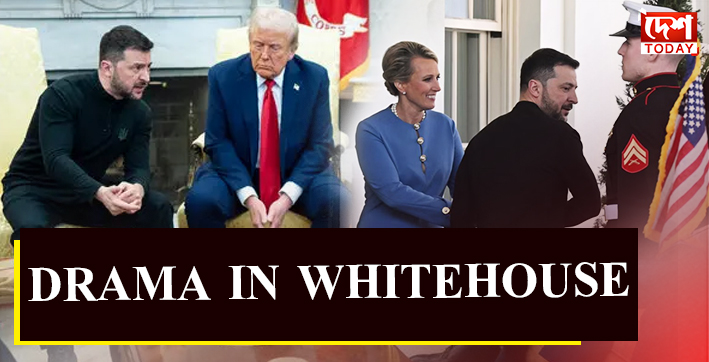
In the Oval Office of the White House, it was not Donald Trump and Volodymyr Zelenskyy facing off—it was as if Alexander the Great and the brave Indian king Porus were standing against each other. In a diplomatic battle that shook the entire world, U.S. President Donald Trump and war-torn Ukraine’s leader Volodymyr Zelenskyy found themselves at odds. No country had invaded another, nor had Ukraine fallen to America. Until now, the two nations had been allies—America had been aiding Ukraine with funds and weapons to counter the Russian invasion. But with Trump taking office on January 20, replacing Democrat Joe Biden, that alliance saw a fundamental shift. The world believes that Trump has a close personal relationship with Ukraine’s invader and America’s longtime adversary, Vladimir Putin.
Trump, known for his business-first mindset over traditional diplomacy, has made even America’s closest allies uncertain. In such a scenario, Zelenskyy, who sought weapons and guaranteed protection in exchange for Ukraine’s mineral resources, found himself humiliated in the Oval Office. When Trump and Vice President J.D. Vance attempted to pressure Zelenskyy into submission, the Ukrainian president defiantly stood his ground—just as Porus did when facing the mighty Alexander.
In 326 BCE, along the banks of what is now the Jhelum River, Porus was defeated by the world-conquering Alexander. But when the captured Porus was asked by Alexander how he wished to be treated, the defeated but proud king replied, “Like a king.” Though he lost the battle, Porus upheld the honor of his kingdom, standing tall before a far more powerful adversary—a tale that remains celebrated in India over a thousand years later. Similarly, in the face of the mighty U.S. president, Zelenskyy stood with equal courage, refusing to sign an agreement to sell Ukraine’s mineral wealth and returning home with his nation’s pride intact.
When Zelenskyy refused to sign the mineral resources deal without a clear assurance of security from the U.S., Trump lost his temper on live television. In front of the cameras, Trump and Vance aggressively pressured Zelenskyy, and the world watched in shock as two allied nations’ leaders engaged in a heated exchange. As the deal slipped from their grasp, Vice President Vance sparked the confrontation with an unusual complaint—why hadn’t Zelenskyy thanked Trump for American aid? Zelenskyy countered that he had repeatedly expressed gratitude, but he could not hand over Ukraine’s resources without a firm guarantee of security against Russian aggression. The discussion quickly escalated.
For the last ten minutes of the 45-minute meeting, the argument reached its peak. As the exchange grew increasingly intense, Trump told Zelenskyy, “I can’t guarantee your security. The way you have behaved is insulting to the U.S. government. You are in a very difficult position. You’re making bold claims, but without our support, you wouldn’t survive two weeks in this war. By refusing to cooperate, you’re inviting the possibility of a third world war.” Trump then threatened that Ukraine must return the $300–350 billion in aid previously provided by the U.S., demanding that Zelenskyy sign the mineral deal in return. However, Zelenskyy firmly responded that he would not hand over half of Ukraine’s mineral wealth—including oil, natural gas, and other resources—without a security guarantee.
In this highly charged atmosphere, Zelenskyy and his delegation were asked to leave the White House. From there, they headed directly to the airport and departed for London.
Trump’s behavior has stunned the world. Critics argue that he is scheming to plunder Ukraine’s resources, possibly with Putin’s involvement. A few days earlier, Trump had offered Ukraine $500 billion in aid but in exchange demanded complete control over its mineral wealth. Though Zelenskyy rejected this demand, he had still been willing to negotiate a mineral deal under fair terms. However, Trump’s unacceptable conditions made him withdraw from negotiations.
This incident could significantly alter the course of the Russia-Ukraine war. Under Biden’s leadership, the U.S. had supported Ukraine wholeheartedly. But with Trump now in power, that support has become uncertain. Trump has made it clear—he is not interested in any charitable assistance. America will only help Ukraine if it profits from the deal. That’s why Zelenskyy had proposed the mineral agreement. But both sides could not agree on key terms.
What were the terms of the mineral deal?
- A trust would be created for Ukraine’s reconstruction, jointly managed by Washington and Kyiv.
- Ukraine would contribute 50% of extracted minerals from state-owned mines to this trust. The funds would be used for Ukraine’s security and development.
- The U.S. would be committed to Ukraine’s economic growth and stability.
- The U.S. would have access to Ukraine’s mineral resources, with the trust primarily controlled by American interests.
Essentially, the U.S. sought to gain control over Ukraine’s natural wealth through this deal. Zelenskyy was somewhat willing to accept these terms in exchange for security guarantees. However, Trump was unwilling to provide such guarantees, prioritizing business interests over political commitments. Instead of offering protection, he appeared to be attempting a complete takeover of Ukraine’s resources.