

The history of India’s space journey has already been written. On 2 April 1984, Indian Air Force Squadron Leader Rakesh Sharma became the first Indian astronaut to soar into space aboard Russia’s Soyuz rocket—a truly golden chapter. On 3 May, while at the Russian space station, when then Prime Minister Indira Gandhi congratulated Rakesh Sharma for his unprecedented feat and asked him how India looked from space—a question every Indian was eager to hear the answer to—Rakesh Sharma, proudly wearing his spacesuit with the Indian national flag patch, famously replied: “Saare Jahan Se Achha!” (Better than the whole world!)—describing India as the most beautiful part of the Earth. Rakesh Sharma’s immortal words have since become a cherished part of India’s space lore.
Now, 41 years after that historic event, it’s time to rewrite a fresh chapter in India’s space history.
‘History repeats itself’—indeed, history is repeating itself.
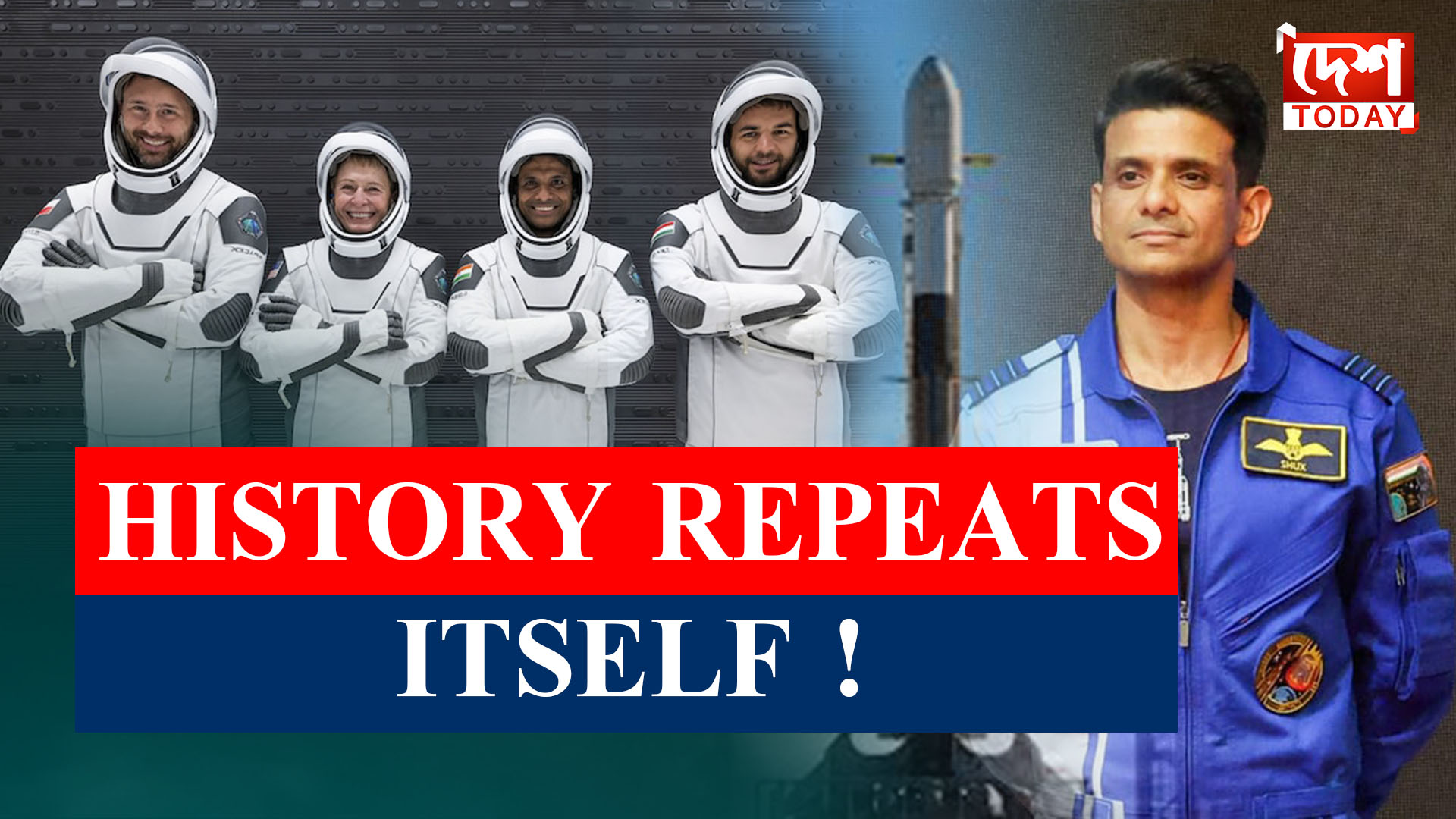
After countless sunrises and sunsets over these 41 years, and after countless cosmic events in the mysterious space above, another Indian Air Force officer, Group Captain Shubhanshu Shukla, is all set to create history once again. If everything goes as planned, next Tuesday, this courageous Group Captain from the Indian Air Force will become the second Indian astronaut. Shubhanshu is scheduled to launch into space from America’s Kennedy Space Center in Florida on Tuesday at 5:52 PM IST. The SpaceX Dragon spacecraft, which had been delayed twice earlier for various technical reasons, is now placed on the launch pad (Pad 39A) of the Kennedy Space Center for the mission, along with Shubhanshu and his three fellow astronauts. This will be the first space mission of the newly built Dragon spacecraft by Elon Musk’s company, SpaceX. The Dragon capsule is mounted atop NASA’s Falcon-9 rocket, and the countdown will begin 24 hours before the launch.
Named “Axiom-4” or “Ax-4,” this space mission will have three other astronauts alongside Indian astronaut Shubhanshu Shukla: NASA astronaut Peggy Whitson as the mission commander, and mission specialists Tiber Kapu from Hungary and Slawosz Uznanski from Poland. Shubhanshu Shukla will be the pilot of this mission, responsible for the critical tasks of launch and docking—the connecting of Dragon to the International Space Station (ISS). Notably, the Axiom-4 spacecraft is largely autonomous, meaning it can operate the mission without manual piloting unless complicated situations arise. For reference, in the recent mission of Indian-origin astronaut Sunita Williams, a malfunction in Boeing’s Starliner spacecraft forced her to manually control and dock the craft to the space station.
The journey of Indian astronaut Shubhanshu and his three teammates will be a 28-hour trip. After launch, they will orbit the Earth and slowly increase their distance until they dock with the ISS at 10 PM IST on Wednesday night. The Axiom-4 mission will last for 14 days on the space station, during which the astronauts will conduct 60 experiments. Shubhanshu alone will conduct 12 of these experiments—seven for India’s space agency ISRO and five for NASA. From the space station, Shubhanshu is also expected to interact with Prime Minister Narendra Modi and with Indian scientists and students, and will even perform yoga in space.
The mission had recently faced uncertainty due to a clash between US President Donald Trump and SpaceX owner Elon Musk, with Musk threatening to separate SpaceX from NASA. But the mission is now moving forward as planned, and for Shubhanshu Shukla’s journey, India has invested 500 crore rupees.