

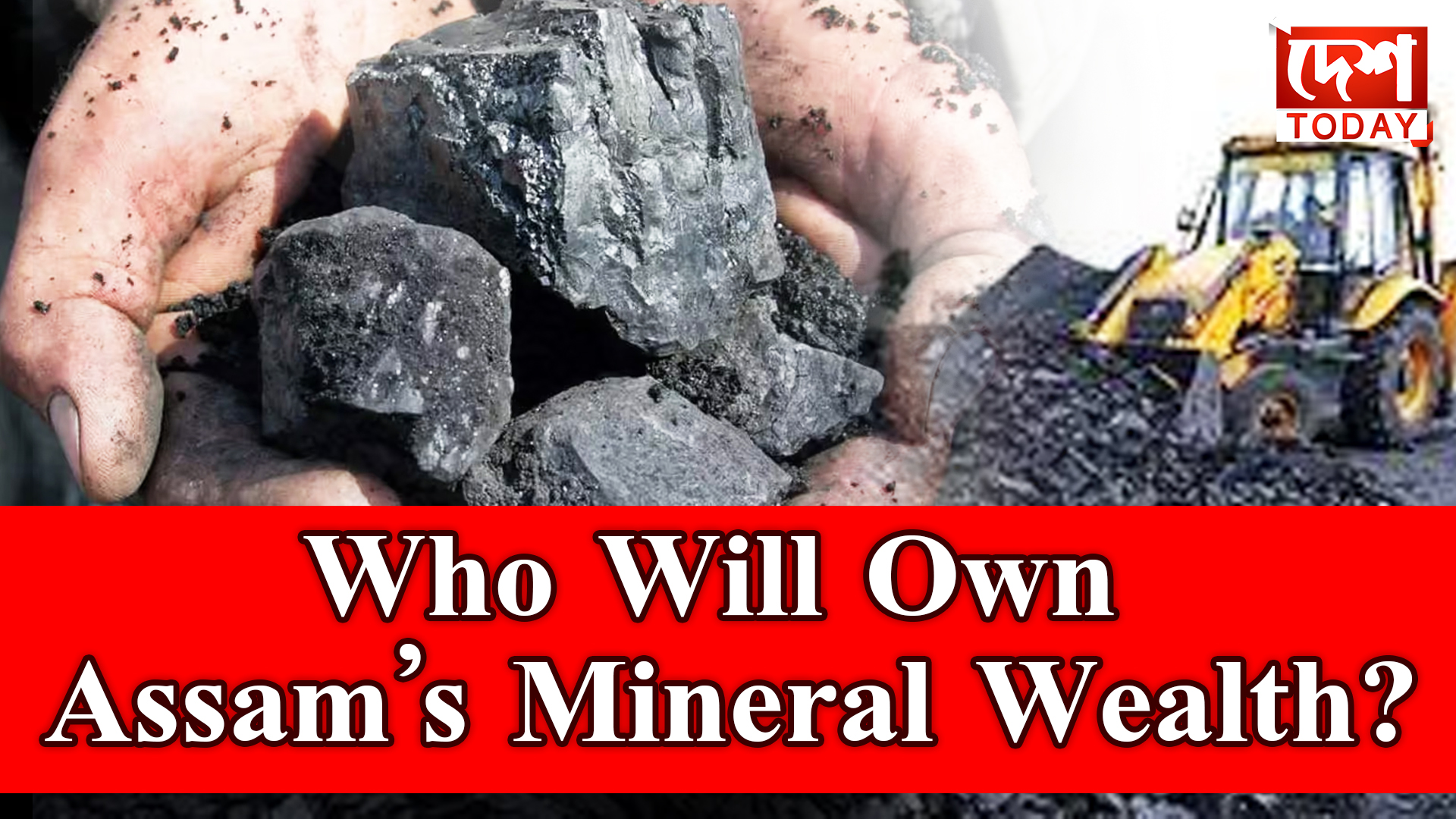
7 Limestone Blocks Already Allotted to Cement Companies…
The so-called Rare Earth Elements (REE) are not truly “rare” in terms of their presence beneath the earth’s surface, but rather due to the rarity of their composition. According to the Periodic Table of Chemistry, Rare Earth Elements – or simply REEs – are a group of 17 chemical elements.
These 17 elements can be found individually in various parts of the world. Their geological presence is widespread, and they can be mined separately. However, this process is extremely time-consuming, expensive, and practically inefficient. But when these 17 elements are found together in a natural combination, they become extraordinarily valuable and are identified as Rare Earth Elements (REEs).
REEs are essential to modern technology and industries. They are indispensable in clean energy, electric vehicles, defense manufacturing, electronics, wind turbines, healthcare, and, most crucially, in the semiconductor industry.
Fortunately, the subsoil of Assam is rich in this highly essential modern mineral. According to a deep study and extensive survey conducted by the Geological Survey of India (GSI), Assam contains an estimated 28.64 million tonnes of Rare Earth Elements. GSI has confirmed the presence of REEs in various regions such as the Samchampi Hills, Samteran Hills, Borpung, Daldali region, Khobak and Garampani belt in Umrangso, Longlokch of Samaguri, Parakhu region of Khatkhati, and the Jonai belt of Silapathar.
Additionally, REEs have been found in the Chapar–Bilasipara region of Dhubri, the Paikan region of Goalpara, and the Parbatjhora area of Kokrajhar. Iron ore has also been discovered in Lengopara and Kumari in Goalpara.
Meanwhile, a sensational revelation by the Geological Survey of India confirms that Dhubri’s Chanderdinga Hills contains 18.29 million tonnes of iron ore.
Furthermore, high silica glass sand, also known as silica sand, has been found in Assam’s Golaghat and Nagaon districts. GSI has also confirmed its presence in Dhubri and Goalpara. In addition, Assam is home to valuable minerals such as graphite and vanadium, with an estimated 17.17 million tonnes of vanadium. GSI has also confirmed the presence of placer gold in the riverbed of the Subansiri River.
It is worth noting that while Assam has long been known for its coal and limestone, recent surveys by GSI have uncovered new zones for both resources.
Context and Timeline:
It is important to highlight that the Geological Survey of India, through its deep and extensive surveys conducted from 2015 to 2024, has successfully uncovered this treasure trove of valuable minerals in Assam. Although Assam’s mineral richness was no secret, stringent mining regulations had prevented any detailed survey until the central government amended the Mines and Minerals (Development and Regulation) Act in 2015. Following this, GSI launched extensive exploration initiatives across Assam and the Northeast.
After confirming the presence of these minerals, GSI has initiated the Critical Mineral Assessment Programme (CMAP) for 2024–25 to assess quantity and facilitate future extraction.
However, discovering these mineral reserves does not mean they will be extracted overnight. It involves a specific process and a long-term plan. Currently, the extraction of Assam’s REEs, iron ore, and silica sand is still in Stage 3 (G-3) of development.
So, Who Owns Assam’s Mineral Wealth?
Despite Assam being mineral-rich, the question remains—who truly owns these resources?
Since Assam is a constituent state of India, all mineral resources fall under the authority of the central government. Therefore, Assam cannot directly extract or sell these resources independently. Once these resources reach the extraction stage, the concerned ministry of the central government will allocate mining rights to specific companies.
However, the case of limestone is somewhat different. Already, seven limestone blocks in Assam have been allotted to various companies:
The Northboro Hangdong-A and Hangdong-B blocks, containing a total of 474.78 million tonnes of limestone, were allocated to Star Cement and Dalmia Bharat Green on 6 and 25 February respectively.
The Southboro Hangdong-C block, with 592.63 million tonnes, was given to Ambuja Cement.
The Boro Hangdong (CL) block was auctioned off to Star Cement (Meghalaya) on 13 March.
If the central government undertakes extraction through public sector enterprises, the state stands to benefit substantially.
However, in recent times, the central government has shown a trend of sidelining public sector companies, leading to the meteoric rise of private sector enterprises.
As such, it appears almost certain that Assam’s mineral wealth will end up in the hands of private corporations. The role of the Assam government will be under sharp public scrutiny.
If this treasure trove of mineral wealth is handed over to corporate giants while ignoring public sector institutions, it will be tantamount to selling off Assam. The Assamese people will never become beneficiaries of their own resources. Instead, a few wealthy industrial groups will flourish.
At most, a labour class workforce will emerge in Assam. And Assamese society knows very well which communities will be expected to shoulder the burden of such labour.